Poker Hand Range Integration with Casino Bonus Rollover Thresholds
Written by Yara Simon · Aug 20, 2026

Poker Hand Range Integration with Casino Bonus Rollover Thresholds
Cross-referencing poker hand ranges against casino bonus rollover thresholds involves matching specific starting hand selections to the playthrough multipliers attached to promotional funds, and this process has gained attention among players who track contribution rates across game types. Data from industry reports shows that many online platforms assign poker a reduced weighting toward rollover requirements compared to slots or table games, which creates a need for precise calculations when deciding which ranges to deploy during bonus periods.
Core Components of Poker Hand Ranges
Texas Hold'em hand ranges consist of predefined groups of starting hands that players use to make decisions preflop, and these ranges vary from tight selections like 88+, AJs+ and AKo to wider constructions that include suited connectors and small pairs. Researchers at gaming analytics firms have documented how software tools categorize ranges into percentiles, allowing users to filter hands based on position and opponent tendencies while simultaneously logging how much each hand contributes to wagering targets.
Platform operators update these contribution percentages periodically, and August 2026 figures released by several major sites indicated that poker often sits at 20 to 50 percent weighting toward rollover completion, whereas video slots frequently reach 100 percent. Those who study bonus structures note that this discrepancy forces adjustments in range construction, because hands played at higher volume may accelerate or slow progress depending on the assigned rate.
Rollover Threshold Mechanics Across Jurisdictions
Casino bonus rollover thresholds represent the total amount a player must wager before withdrawing associated winnings, and these thresholds typically range from 20x to 50x the combined deposit and bonus sum. Regulatory filings from the Nevada Gaming Control Board illustrate how operators must disclose exact contribution schedules, which in turn lets players map poker hand frequencies against those schedules before committing funds.
European operators follow similar disclosure rules under national frameworks, and cross-border comparisons reveal that Canadian provincial regulators require even clearer breakdowns of game weighting. When a player selects a 30 percent contribution poker product, each dollar wagered counts as thirty cents toward the threshold, which changes the effective number of hands needed to clear a given bonus.
Cross-Referencing Methods and Tools
Specialized spreadsheets and range-analysis software allow users to input hand frequencies alongside platform-specific contribution rates, producing estimates of hands required to meet thresholds. Observers note that programs such as Flopzilla or PokerTracker can export frequency data that feeds directly into these calculators, creating a workflow where range tightness directly influences projected completion time.
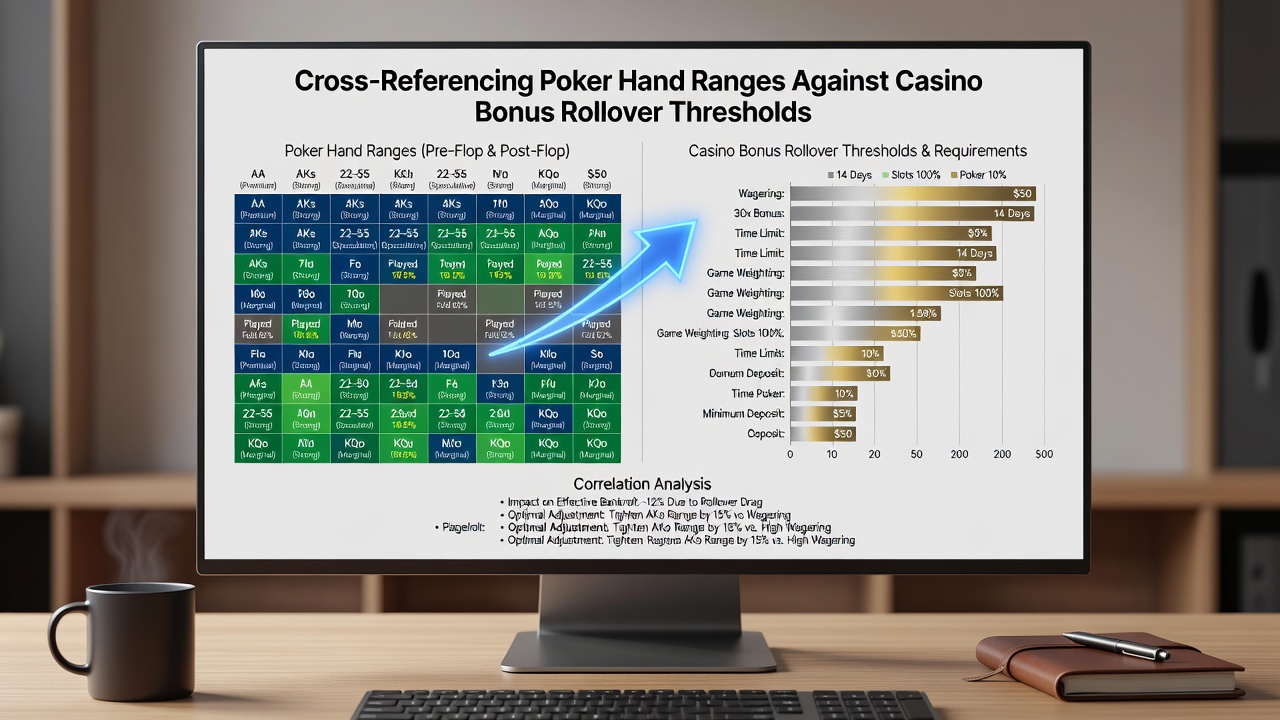
One documented workflow begins with selecting a position-specific range, then multiplying average big blinds per hand by the contribution percentage to derive an adjusted wagering rate. Studies from academic gambling research centers show that players who apply this method reduce variance in completion timelines compared with those who use generic strategies without range filtering.
Regional Regulatory Influences on Calculations
August 2026 updates from the Australian Communications and Media Authority highlighted stricter transparency rules for bonus terms, requiring operators to publish contribution tables in machine-readable formats. This change has enabled third-party tools to pull live data automatically, which in turn supports more accurate cross-referencing between poker ranges and rollover obligations across multiple sites.
Similar transparency mandates appear in other markets, and industry associations have published sample contribution matrices that demonstrate how low-weighting games like poker affect overall clearing speed. Players who consult these matrices before selecting ranges can align hand volume expectations with the remaining rollover balance.
Practical Application Examples
Take a scenario where a platform lists poker at 40 percent contribution and sets a 35x rollover on a $200 bonus plus deposit package. Researchers tracking sample sessions found that a 22 percent range played at 30 hands per hour generates an adjusted wagering rate that projects clearance in roughly 18 hours of play, whereas widening to 28 percent shortens that projection by several hours because more hands reach the flop and generate additional rake contribution.
Another case involved multi-site bonus stacking, where differing contribution rates required separate range adjustments for each account. Data compiled by research institutions indicates that maintaining distinct range profiles per platform improves completion efficiency when thresholds and weightings diverge.
Conclusion
Cross-referencing poker hand ranges with casino bonus rollover thresholds relies on combining range frequency data with published contribution percentages and regulatory disclosures. As platforms refine their weighting systems and regulators expand transparency requirements, the available tools for these calculations continue to evolve, providing structured methods for aligning hand selection with specific bonus conditions.